Danny Marmorstein Music
Danny loves to sing. He loves to play keyboards. He is a composer expressing his love for humanity and nature.
Danny's formative years as a musician were immersed in piano lessons and singing in temple. His musical journey has included background singing for the legendary Carpenters, whom he recorded and toured with. The journey continues.
Danny is very spiritual. He is a Rabbi and Cantor who takes delight in studying sacred texts. The son of a Holocaust survivor and supportive mother, Danny inherited a unique sensitivity and profound appreciation of life.
Danny is a funny guy, taking opportunities to zing clever puns, many original. He is an artist, a thinker, a man of faith, a creator, a leader, and above all, a deeply good soul.


Danny Marmorstein: Composer and Pianist.
Paul Hoyle: Recording and Engineering.
I was Divinely inspired to create a piano piece based on Modest Musorsky's Pictures at an Exhibition but using Chanukah themes. The concept is that of an observer strolling from picture to picture in an art museum, stopping to study each work. My composition is a composite of Hebrew songs from my Ashkenazic heritage. Here is an explanation of each movement:
Ma'oz Tzur (commonly translated as Rock Of Ages) is traditionally sung after lighting the Chanukah candles and singing the candle blessings. The Maccabees were Jewish warriors who fought the oppressive Seleucid Empire in the second century BCE. The song reflects upon that time and other times of oppression against the Jewish people. Ma'oz Tzur is a testament to the Jews' faith in G-d. Of its 6 stanzas only the first is traditionally sung, first in Hebrew then in English. The song is not a hymn but is sung like a hymn.
Banu Choshech Legaresh translates as We Come To Chase The Dark Away. I picture the Maccabees marching from afar, getting louder and marching faster as they approach the enemy.
Ma'oz Tzur - a reprise of the opening melody but played elegantly, as a promenade in a grand ballroom. The melody abruptly takes a dark turn, an ominous sign of things to come.
Hayo Haya is a Hebrew way of saying Once Upon A Time, but unlike the beginning of a fairy tale, this song tells the true story of the wicked King Antiochus IV and his quest to murder the Jews. I first heard it performed by Peter, Paul and Mary. The instrumental interludes between the verses took me back to the time of the Jewish shtetls, the little villages in Eastern Europe, as the Nazis rose to power. I probably listened to this recording 20 or more times in a row, bawling my eyes out. Why did it hurt me so deeply? My father survived Auschwitz. His parents and many more in our family did not.
Sheyiboneh Beit Hamikdash translates as That The Temple Should Be Built, but in actuality its meaning is that The Temple, the great temple in Jerusalem twice destroyed, should be built again. The Temple Mount is widely acknowledged as the holiest site in Judaism and Jews would love to see it restored as during the days of King Solomon. The Temple Mount is also deeply revered by Christians and Muslims. I believe that one day all faiths will be welcomed to the Mount, appreciative of one another, and respectful of one another's deep devotion to the land.
During this middle of this movement the tonal mode changes and I dream of the temple rebuilt and people once again promenading in a grand ballroom. Then the dream ends, and (with the reprise of Hayo Haya) the reality of the wicked king returns.
Candle Blessing is the traditional melody sung when lighting the candles on the chanukiah or, as many of us refer to it, the menorah. This gallery picture everyone is looking at is a chanukiah.
Sivivon is Hebrew for dreidel, a spinning top with 4 sides. Each of the sides has a Hebrew letter representing the miracle of Chanukah. While the letters address one great miracle, the holiday is a celebration of several miracles, including the victory of the Maccabees and the discovered holy oil which lasted eight days when the projection was for only a single day. There is a game using the sivivon, enjoyed by all ages, in which each player is given an equal share of money and takes a turn spinning it. Each letter represents how much that player will take or give to a central pot. Pennies and chocolate money, called gelt, are often used.
Candle Blessing - The same traditional melody, now in a minor key. Sivivon is in a minor key and that is why I chose to stay in minor, using it to modulate from minor to major in the next movement.
Ner Li translates as My Candle and one line of the lyrics translates as My Candle Will Glow Bright. I first heard this melody sung by a children's choir. I thought of a music box because many times it is given to a child, captivated by the music and the decorative box.
Ma'oz Tzur - another reprise of the opening melody, played triumphantly. The American composer Charles Ives used to interject short fragments of American patriotic melodies into his compositions. In jazz we call this quoting. Towards the end of this movement, I quoted the melody of the line in the national anthem of our United States that reads "and the rocket's red glare". I think of Tchaikovsky's 1812 Overture and picture canons going off 3 times in this movement after each quote. And the rocket's red glare BOOM ... the bombs bursting in air BOOM ... gave proof through the night that our flag was still there BIG BOOM! Chanukah is also named the Festival of Lights. I associate the rocket's red glare used in a wartime victory of United States with the lights of the menorah representing a wartime victory in Jewish history. As the Great Gate of Kiev dramatically closes Tchaikovsky's work, Ma'oz Tzur dramatically closes this composition.
Danny Marmorstein: Music and lyrics, Piano and vocals.
Yehuda Glantz: Editing and Keyboards, Arrangement
Doron Toister: String Arrangement and Cello.
Yom Echad translates into One Day:
not just for one day, but forever more.
Two great nations, proud nations, are at war, but one day I truly believe they will have peace.
While at war both nations suffer, but so does The Land.
The Land cries out to G-d "When will it stop?"
The most important message; Always Have Hope.
Danny Marmorstein Music

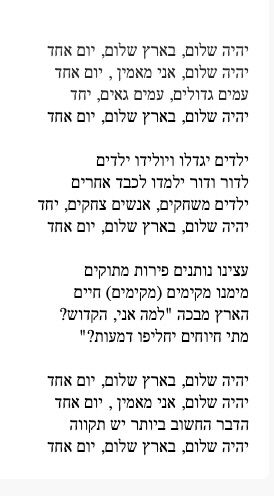
There will be peace in the land, one day.
There will be peace, I believe, one day.
Great nations, proud nations, together
There will be peace in the land, one day.
The children will grow and they will have children.
From generation to generation they will learn to honor others.
Children playing, people laughing, together
There will be peace in the land, one day.
Our trees give sweet fruit.
Our waters sustain life.
The Land cries out "Why me, Lord?
When will smiles replace the tears?"
There will be peace in the land, one day.
There will be peace, I believe, one day.
The most important thing - have hope
There will be peace in the land, one day.